
University of Indonesia History: From Colonial Era to Today
The University of Indonesia keeps growing into one of Asia's top institutions. Trace University of Indonesia history from colonial times to today.

Contents
- Beginnings in the Colonial Era (1849)
- Developments in the Later Colonial Period (1920s to 1940s)
- The Revolution and the Birth of Universitas Indonesia (1945-1950)
- An Important Role in the Early Years of Independence (1950s-1960s)
- New Campus Construction and Modernization (1970s-1990s)
- Toward a World-Class University (2000s to Present)
- Closing
Universitas Indonesia (UI), known in English as the University of Indonesia, is one of the oldest and most prestigious universities in the country. With a long history spanning several centuries, UI is not only a center of higher education in Indonesia but has also played an important part in the intellectual and political development of the nation. From the colonial era to the modern day, Universitas Indonesia has kept growing into a leading educational institution in Southeast Asia. This article looks back at UI's long journey from the colonial period to the present.
Beginnings in the Colonial Era (1849)
The history of Universitas Indonesia began under Dutch colonial rule, in 1849, when a medical school known as the Dokter-Djawa School was founded in Batavia (now Jakarta). The school was set up to train native doctors who would serve in remote parts of the Dutch East Indies. It was inaugurated by Governor-General Jan Jacob Rochussen as an effort by the Dutch colonial government to improve the health of the native population while keeping control of colonial policy.
In 1902, the school was renamed School tot Opleiding van Indische Artsen (STOVIA), or the School for the Education of Indies Doctors. STOVIA produced a number of important figures in the history of Indonesia's national movement, including Dr. Tjipto Mangoenkoesoemo, Dr. Wahidin Soedirohoesodo, and many more.
Developments in the Later Colonial Period (1920s to 1940s)
In 1927, the colonial government founded Indonesia's first institution of higher technical education, known as the Technische Hoogeschool te Bandoeng (THS) in Bandung, which later became the forerunner of the Bandung Institute of Technology (ITB). This was one of the first steps in developing higher education in Indonesia.
In 1940, the Rechts Hoge School (RHS), a law school, was also established, and it became the foundation of today's UI Faculty of Law. This period marked the growth of various fields of study in the Dutch East Indies, alongside a growing need for professionals in engineering, law and medicine.
The Revolution and the Birth of Universitas Indonesia (1945-1950)
After Indonesia proclaimed its independence in 1945, education in Indonesia changed greatly, including in Batavia (Jakarta). In 1946, after independence, Indonesians began taking over the educational institutions that the Dutch had previously run. This is where the idea of merging the various existing colleges into a national university began to emerge.
On February 2, 1950, the Indonesian government officially established Universitas Indonesia. The university was formed by merging various existing colleges, including STOVIA (which later became the Faculty of Medicine), RHS (which became the Faculty of Law), and other technical and science schools. These faculties were spread across several cities, such as Jakarta, Bandung, Surabaya and Makassar. UI became a symbol of higher education in newly independent Indonesia.
An Important Role in the Early Years of Independence (1950s-1960s)
In the early years of independence, UI played an important part in nation building, both through education and through its role in political movements. Many nationalist figures and intellectuals were UI graduates, and they went on to help form the Indonesian government in the early independence era. In this period, UI was also a place for discussion and intellectual movements that shaped the face of Indonesian politics.
But UI's rapid growth also brought challenges. In 1959, because of the growing number of students and demand for more specialized education, UI campuses outside Jakarta, such as the Faculty of Engineering in Bandung and the Faculty of Medicine in Surabaya, were separated and became independent universities. The Faculty of Engineering in Bandung became the Bandung Institute of Technology (ITB), and the Faculty of Medicine in Surabaya became Universitas Airlangga.
New Campus Construction and Modernization (1970s-1990s)
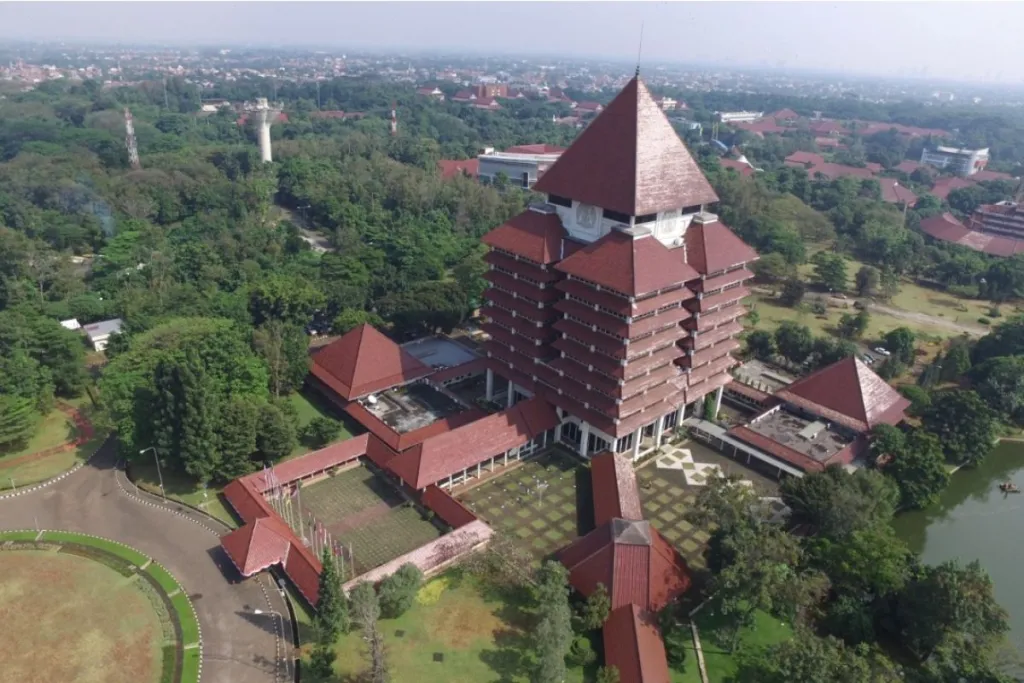
In the 1970s, Universitas Indonesia went through a period of major modernization and expansion. The Indonesian government recognized the importance of providing a more modern and integrated campus to accommodate the growing number of students. In 1987, a new Universitas Indonesia campus opened in Depok, West Java. The Depok campus was built to replace the Salemba campus, which could no longer hold the growing number of students.
The Depok campus was designed as a modern integrated campus, with educational facilities, a library, laboratories and student dormitories. It marked the start of a new era for UI as one of the leading universities in Indonesia, with facilities on par with the best universities in the world.
During this period, UI also kept expanding its academic programs, opening new faculties such as the Faculty of Computer Science, the Faculty of Economics, and the Faculty of Social and Political Sciences. This strengthened its position as a university producing graduates in a wide range of fields.
Toward a World-Class University (2000s to Present)
Entering the 21st century, Universitas Indonesia focused not only on national education but also sought to establish itself as a world-class university. UI has increased international cooperation with leading universities around the world and has become a member of various international education organizations.
In 2010, UI ranked first in the ranking of universities in Indonesia and has kept working to hold its position globally. UI is also involved in a range of research and innovation that supports the development of science in Indonesia. One of its well-known international programs is UI GreenMetric, a ranking of the world's universities based on their commitment to environmental sustainability.
UI has also been a pioneer in technology-based education innovation in Indonesia, introducing a variety of distance learning and e-learning programs. With ever-growing facilities and outstanding human resources, UI strives to remain a center for research and development of science that can contribute significantly to Indonesia's development.
Closing
The history of Universitas Indonesia reflects the long journey of higher education in Indonesia, from the colonial era to the modern day. UI has gone through many changes, challenges and developments that have made it one of the leading universities in Southeast Asia. With a strong intellectual tradition and a commitment to education and research, UI plays an important part not only in shaping Indonesia's younger generation but also in building a brighter future for the nation.
From the colonial era to today, Universitas Indonesia keeps innovating, adapting and leading higher education in Indonesia, holding its place as a symbol of academic excellence ready to face global challenges in the future.